
In the modern parenting landscape, we are often told that “more is more.” We track hours of sleep, minutes of screen time, and the nutritional density of every meal. Recent research confirms that these parental behaviors are indeed the “social wires” that build a child’s neurobiological framework. A comprehensive scoping review by Maia et al. (2025) highlights that our daily routines—the way we manage sleep, eating, and activity—directly shape a child’s self-regulation and long-term mental health.
However, in our quest to manage these variables perfectly, we often fall into the trap of “Parent-Led Logistics.” We become drill sergeants of the morning, focused on the quantity of tasks completed rather than the quality of the connection made.
The Shift: From Quantity of Time to Quality of Transition
There is a growing, liberating consensus in developmental psychology: in our busy world, a massive quantity of time may not be as vital as we once thought. Instead, the focus has shifted to the quality of specific “windows” of interaction. As Schneider et al. (2022) notes, a lack of parental responsiveness and warmth during these windows is a primary predictor of behavioral struggles.
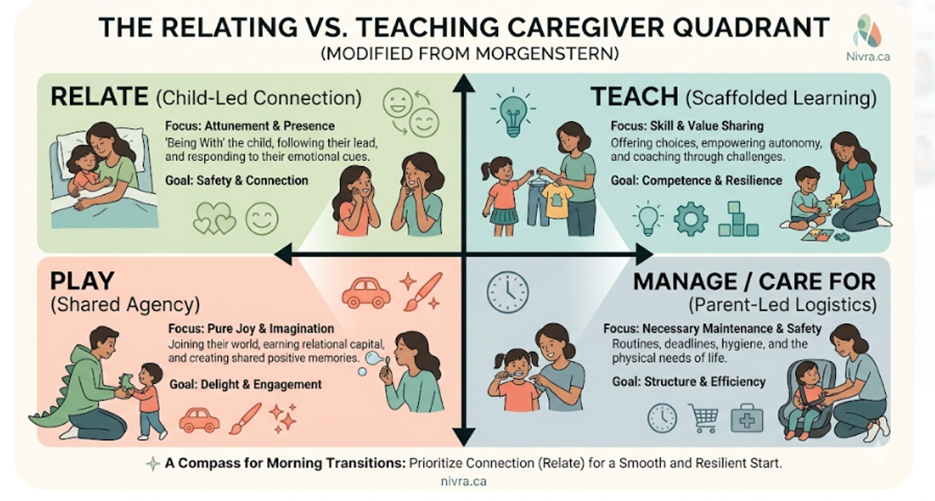
This brings us to a radical idea: the most important part of your day isn’t the two hours of park time in the afternoon—it is the two minutes of transition in the morning. To visualize this shift, we can look at the Caregiver Quadrant:
Entering the “Relate” Quadrant: Child-Led Connection
As shown in the quadrant above, our goal is to move from the bottom-right (Manage) into the top-left (Relate). In the Relate quadrant, the focus is pure attunement. It is about “being with” the child, following their lead, and responding to their emotional cues rather than our own to-do lists. This is the foundation of safety and connection. When we prioritize this quadrant during transitions, we aren’t just “playing”; we are providing the neurobiological buffering children need to face the challenges of the “Manage” and “Teach” moments later in the day.
Mastering the “Seams” of the Day: The Morgenstern Method
Julie Morgenstern, a pioneer in time management, famously describes transitions as the “seams” of our day. When we rush, we pull too hard on these seams, causing the emotional regulation of the family to unravel. To prevent this, Morgenstern suggests a shift in perspective: Connection before Direction.
1. The Power of the Five-Minute Snuggle
Morgenstern identifies the first transition—Sleep to Wake—as the most critical for a child’s nervous system. Instead of an immediate list of chores, she advocates for a short, child-led “Relate” period.
- The Goal: Gentle arousal of the nervous system.
- The Action: A 5-minute snuggle where you follow the child’s sensory lead. If they want to whisper about a dream or simply sit in silence, you follow. This builds what Feldman (2021) calls “bio-behavioral synchrony,” priming the child’s brain for a social, non-stressed day.
2. Parent Preparation: The Secret to Co-Regulation
One of Morgenstern’s most vital insights is that for a morning to be child-led, the parent must be prepared beforehand. Co-regulation—the process by which a caregiver’s calm nervous system helps settle a child’s—cannot happen if the parent is also in a state of high-cortisol rush.
- “The Pause”: Morgenstern suggests that the adult must be ready (dressed, caffeinated, packed) before the child is even awake.
- The External Regulator: When you are prepared, you can afford to be the “External Regulator.” If a child dawdles or has a “transitional object” they want to bring from the bedroom to the kitchen, you have the emotional bandwidth to say yes. This maintains their sense of agency and prevents the “Cortisol Spike” that Madigan et al. (2024) warns can happen when children feel forced or dragged.
3. Languaging the Shift
As we move through the morning transitions—from eating to dressing, or play to the door—Morgenstern advocates for “Choice Protocols.” Instead of commanding (“Put on your coat”), we offer child-led agency within a boundary: “Do you want to put your arms in first, or should I hold it for you?” This mirrors the findings of Veraksa et al. (2021), which show that while children need adult support, it is the moments of child-led agency that specifically build inhibitory control and executive function.
Summary: A Compass for Nivra Parents
By slowing down at these specific “seams” and preparing ourselves to be present, we move out of the “Manage” quadrant and into the “Relate” quadrant. As an RCC, I see this as a “quiet revolution.” You aren’t just getting them to school on time; you are signaling their inherent worth before they ever step foot out the door.
If this sounds like what you’re looking for, learn more about Family Therapy at Nivra
References & Further Reading
Bernier, A., Beauchamp, M. H., & Cimon-Paquet, C. (2021). From the cradle to the classroom: The social origins of executive function. Current Directions in Psychological Science, 30(3), 224–229. https://doi.org/10.1177/09637214211004128
Feldman, R. (2021). Parent–infant synchrony and the construction of shared timing: Physiological precursors, developmental outcomes, and risk conditions. In J. J. Lockman & C. S. Tamis-LeMonda (Eds.), The Cambridge Handbook of Infant Development (pp. 30–54). Cambridge University Press. https://doi.org/10.1017/9781108399838.004
Havik, E. K., Westergård, E., & Idsøe, T. (2024). Responsive caregiving and child development: A longitudinal analysis of the impact of parental sensitivity on cognitive milestones. Frontiers in Psychology, 15. https://doi.org/10.3389/fpsyg.2024.13024
Maia, C., Braz, D., Fernandes, H. M., Sarmento, H., & Machado-Rodrigues, A. M. (2025). The impact of parental behaviors on children’s lifestyle, dietary habits, and mental health: A scoping review. Children, 12(2), 203. https://doi.org/10.3390/children12020203
Morgenstern, J. (2018). Time to Parent: Organizing Your Life to Bring Out the Best in Your Child and You. Little, Brown Spark.
O’Keeffe, J., & McNally, S. (2023). Play as a facilitator of social and communication skills: Review journal of autism and developmental disorders. Springer Nature, 10, 51–81.
Provenzi, L., Fuertes, M., Mariani Wigley, I. L. C., & Nazzari, S. (2024). Editorial: From social wires to neurobiological connections: A neuropsychobiological focus on parent-child interaction. Frontiers in Behavioral Neuroscience, 18. https://doi.org/10.3389/fnbeh.2024.1487555
Schneider, M., Falkenberg, I., & Berger, P. (2022). Parent-child play and the emergence of externalizing and internalizing behavior problems in childhood: A systematic review. Frontiers in Psychology, 13. https://doi.org/10.3389/fpsyg.2022.822394
Tamis-LeMonda, C. S., Kuchirko, Y., & Suh, D. D. (2021). The power of ordinary moments: The everyday context of language and cognitive development. In J. J. Lockman & C. S. Tamis-LeMonda (Eds.), The Cambridge Handbook of Infant Development (pp. 785–813). Cambridge University Press. https://doi.org/10.1017/9781108399838.034
Veraksa, A., Almazova, O., & Bukhalenkova, D. (2021). Do children need adult support during sociodramatic play to develop executive functions? Early Education and Development, 32(4), 585–601. https://doi.org/10.1080/10409289.2020.1780447
Yates, T. M., Egeland, B., & Sroufe, L. A. (2022). Scaffolding child autonomy: A decade in review of the longitudinal impact of autonomy support. Journal of Applied Developmental Psychology, 78, 101375. https://doi.org/10.1016/j.appdev.2021.101375